| COURSEWORK: QUESTION PAPER(Re sit) | Spring 2024 Semester-long |
| Module Code: | HR4053NI |
| Module Title: | Managing People in Organisations |
| Module Leader: | Prabhat Koirala (Islington College) |
| Coursework Type: | Project Individual workbook consisting of a set of cumulative weekly tasks to build on HR concepts and knowledge |
| Coursework Weight: | This coursework accounts for 100% of your total module grades. |
| Submission Date: | 28th July, 2024 |
| When Coursework is given out: | 15th July, 2024 |
| Submission Instructions: | Submit the following at the MST platform on a single PDF format. The following naming convention should be followed while submitting: 1 x Final Submission PDFFile name example: 12312324 Darshan Gyawali There are 3 tasks provided in the coursework, which needs submission as per the instruction provided. Attempt all questions. |
| Warning: | London Metropolitan University and Islington College take Plagiarism seriously. Offenders will be dealt with sternly. |
Individual coursework 1:


Project: Individual workbook consisting of a set of cumulative weekly tasks to build on HR concepts and knowledge (100 marks)
Learning outcome(s) of the assessment:
LO 1. To understand and evaluate the meaning and nature of a range of relevant people management practices that organisations can implement to effectively manage the workforce.
LO 2. To develop knowledge and skills to function as an effective people manager
Section B: Introduction
The module has one summative assessment which requires the student to develop a student workbook/ handbook based on your reflection upon the learning developed from the lectures, tutorial and in-class discussions.
This will not only test students’ understanding of the issues in people management, allowing for difference at industry level (LO1) but will also ask students to reflect on the professional ‘people management’ skills they have developed on the module (LO2). For example, reflective of their leadership and team working style, or how ‘difficult’ it is to construct a structured interview to select the ‘perfect employee’.
The workbook is based on seminar activities so students will receive formative feedback on their ideas from teaching staff in class on a weekly basis – so attendance is paramount to get the most out of this module. Seminar leaders will offer support for academic writing and referencing and there will be the opportunity for formative feedback on the assignment.
These tasks must represent the work of individual students and references to published works must be cited. Plagiarism constitutes an examination offence and if discovered will render a student(s) liable to the appropriate provisions of the University’s Examination Regulations.
Section C: Assessment Strategy
Students need to submit all the questions answers assigned in the following section- ‘Task Details’. The word limit of each answer should be between 250-300 words. Students need to cite the relevant theory to support their points and illustrate with empirical evidence using Harvard referencing.
Task details
Attempt all questions. All questions are equally marked.
Word limit per question: 250 to 300 words per question
A. Explain strategic HRM. Why do you think organisations need to consider the HR department as a regulated body?
B. How can managers overcome biases during selection interviews?
C. Explain the psychometric test method with examples.
D. Explain the importance of training and development in organisation.
E. What do you mean by psychological contract? How does it impact organisational performance?
F. Do you think the practice of academic writing is practical in real life? Explain.
G. Briefly explain two leadership theory with real examples
i. Transformational Leadership
ii. Servant Leadership
Note: You should cite relevant theory to support your points and illustrate them with empirical evidence using Harvard referencing
Section D: Assessment Submission
You need to submit a digital copy of each task at the MST platform in one single file as the guideline provided here. Take help from your module lecturer or tutor for this. The college will not accept any printed copies for this assessment.
Use the correct cover page and name convention.
Word count for the individual report: 250-300 words per questions
Section E: Marking Criteria: How will you be evaluated?
The grade will be awarded based on the following marking Criteria for a Individual written workbook
- Introduction
- Critical analysis
- Use of Related Examples
- Use of Relevant theory
- Writing Structure
- Word limit
- Conclusion
- Citation and Referencing
Formatting (Arial, Font Size: 12, Line Spacing 1.5,)
Section F: Recommended Table of contents
N/A
Section G: Recommended Reading for references
- Huczynski, A., Buchanan, D.A. and Huczynski, A.A., 2013. Organizational behaviour (p. 82). London: Pearson.
- Redman, T., Wilkinson, A., and Dundon, T. 2016. Contemporary human resource management: Text and cases. Pearson Education.
- Edwards, M.R. and Bach, S., 2012. Human Resource Management in Transition. Managing Human Resources: Human Resource Management in Transition, pp.1-17.
Section H: Assessment Grade Description
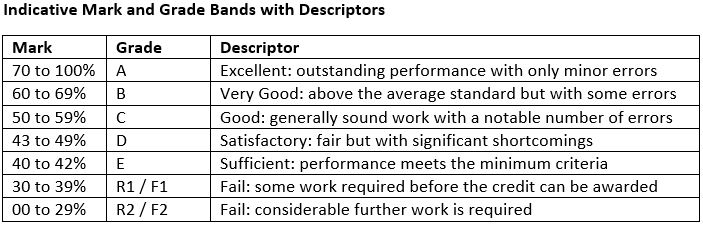
GSBL UNDERGRADUATEGENERAL GRADE DESCRIPTORS
| Level 3/4 | Level 5 | Level 6 | |
| General | Acquisition of broad knowledgeEvaluate informationUse information to plan, develop and problem solve | Generate ideas through analysing conceptsDemonstrate a command of specialised skillsFormulate responses to well defined and abstractAnalyse and evaluate information | Critically review, consolidate and extend a body of knowledge using specialised skillsCritically evaluate concepts and evidence from a range of sourcesTransfer and apply skills and exercise significant judgement in a range of situations |
| 70-100 (A) | Very goodDemonstration of very good comprehension of the task with evidence of analysis, synthesis, evaluation and critical appraisalUse of a wide variety of appropriate sourcesTransformation of knowledgeIndependent thinking and development of ideasAbility to communication very clearly and effectivelyVery good evidence of preparationVery good organisation, structure and presentation of work – minimal errorsGood references, appropriate sources (quality and quantity). No errors in reference list or citations. | ExcellentAdvanced scholarshipGoes beyond the material providedExcellent link to researchExcellent analysis, synthesis, evaluation and critical appraisalExcellent evidence of preparationComprehensive and critical understanding of the topicExcellent ability to communicate clearly and effectivelyExcellent organisation, structure and presentation of workGood references, appropriate sources (quality and quantity). No errors in reference list or citations. | Excellent – Outstanding (for use at far end of range)Outstanding understanding, exploration and insightStrong evidence of originality and development of own ideasDevelop a highly complex argumentOutstanding ability to communicate topics clearly and conciselyAdvanced organisation, structure and presentation of workGood references, appropriate sources (quality and quantity). No errors in reference list or citations.References well utilised and critiqued |
| 60-69 (B) | Very goodDemonstration of very good comprehension of the task with evidence of analysis, synthesis, evaluationUse of a wide variety of appropriate sourcesTransformation of knowledgeIndependent thinking and development of ideasAbility to communication clearly and effectivelyVery good evidence of preparationVery good organisation, structure and presentation of work – minimal errorsGood references, appropriate sources (quality and quantity). Minimal or no errors in reference list or citations. | Very goodDemonstration of very good comprehension of the task with evidence of analysis, synthesis, evaluationUse of a wide variety of appropriate sourcesTransformation of knowledgeIndependent thinking and development of ideasAbility to communication clearly and effectivelyVery good evidence of preparationVery good organisation, structure and presentation of work – minimal errorsGood references, appropriate sources (quality and quantity). Minimal or no errors in reference list or citations. | Very GoodAdvanced scholarshipGoes beyond the material providedVery good link to researchVery good analysis, synthesis, evaluation and critical appraisalVery good evidence of preparationComprehensive and critical understanding of the topicVery good ability to communicate clearly and effectivelyVery good organisation, structure and presentation of workGood references, appropriate sources (quality and quantity). No errors in reference list or citations. |
| 50-59 (C) | Adequate – SatisfactorySome analysis but limitedSome insight and exploration of ideasSound conclusionsNo significant inaccuracies or omissionsSome analysis, evaluation or synthesis of informationLacking clarity at timesSome evidence of preparationReferencing is sound. Mostly appropriate sources. Numerous errors or inconsistencies | Adequate – SatisfactorySome evidence of thinking independently to develop own ideasEvaluation of relevant theories or literatureReasonable ability to communicate clearly and effectivelyReport information in a structured wayUse of an appropriate formatQuite comprehensive knowledgeSatisfactory evidence of preparationSatisfactory referencing, appropriate sources.Numerous but minor errors in references | Adequate- SatisfactoryEvidence of thinking independently to develop own ideasEvaluation of relevant theories or literatureAbility to communicate clearly and effectivelyReport information in a structured wayUse of an appropriate formatReasonably Accurate, quite comprehensive knowledgeSatisfactory evidence of preparationCoherent and well presented – minor errorsSatisfactory referencing, appropriate sources.Minor errors in references |
| 40-49 (D) | All learning outcomes metCompetent (practical)May be incomplete in knowledge (some errors or omissions)Insufficient analysis, evaluation or synthesisLimited application of theories/knowledgeAn awareness of appropriate principles/theories/techniquesIrrelevance to the task at timesDisorganised work with weak standard of presentationNumerous aberrations from the requirements of the taskReferencing is attempted although may be inconsistent, many errors, weak sources | All learning outcomes metCompetent (practical)May be incomplete in knowledge (some errors or omissions)Weak or no analysis, evaluation or synthesisSome application of theories/knowledgeAn awareness of appropriate principles/theories/techniquesIrrelevance to the task at timesDisorganised work with weak standard of presentationAberrations from the requirements of the taskReferencing is attempted although may be inconsistent, many errors, weak sources | All learning outcomes metCompetent (practical)May be incomplete in knowledge (some errors or omissions)Weak or no analysis, evaluation or synthesisSome application of theories/knowledgeAn awareness of appropriate principles/theories/techniquesIrrelevance to the task at timesDisorganised work with weak standard of presentationAberrations from the requirements of the taskReferencing is attempted although may be inconsistent, many errors, weak sources |
| Condoned Pass 30-39 (R2/F1) | Learning outcomes not metLittle relevant knowledgeLacking structureNumerous errors in structure and formLimited understanding of concepts/theoriesNo appropriate analysis, evaluation or synthesisSignificant inaccuracies/omissionsNot competentLittle or no attempt to use references and if so very weak with errors | Learning outcomes not metLittle relevant knowledgeLacking structureNumerous errors in structure and formLimited understanding of concepts/theoriesNo appropriate analysis, evaluation or synthesisSignificant inaccuracies/omissionsNot competentLittle or no attempt to use references and if so very weak with errors | Learning outcomes not metLittle relevant knowledgeLacking structureNumerous errors in structure and formLimited understanding of concepts/theoriesNo appropriate analysis, evaluation or synthesisSignificant inaccuracies/omissionsNot competentLittle or no attempt to use references and if so very weak with errors |
| Under 30 (R2/F2) | Little engagement with the taskNo basic understanding of the subject matterPoor communication (written or verbal)Lacking or no structureSignificant errors in structure and formMany significant inaccuracies/omissions – very little correctLittle or no attempt to use references and if so very weak with many significant errors | Little engagement with the taskNo basic understanding of the subject matterPoor communication (written or verbal)Lacking or no structureSignificant errors in structure and formMany significant inaccuracies/omissions – very little correctLittle or no attempt to use references and if so very weak with many significant errors | Little engagement with the taskNo basic understanding of the subject matterPoor communication (written or verbal)Lacking or no structureSignificant errors in structure and formMany significant inaccuracies/omissions – very little correctLittle or no attempt to use references and if so very weak with many significant errors |
| (0%) | No submissionNothing of relevance in the work submitted | No submissionNothing of relevance in the work submitted | No submissionNothing of relevance in the work submitted |
End of the Document