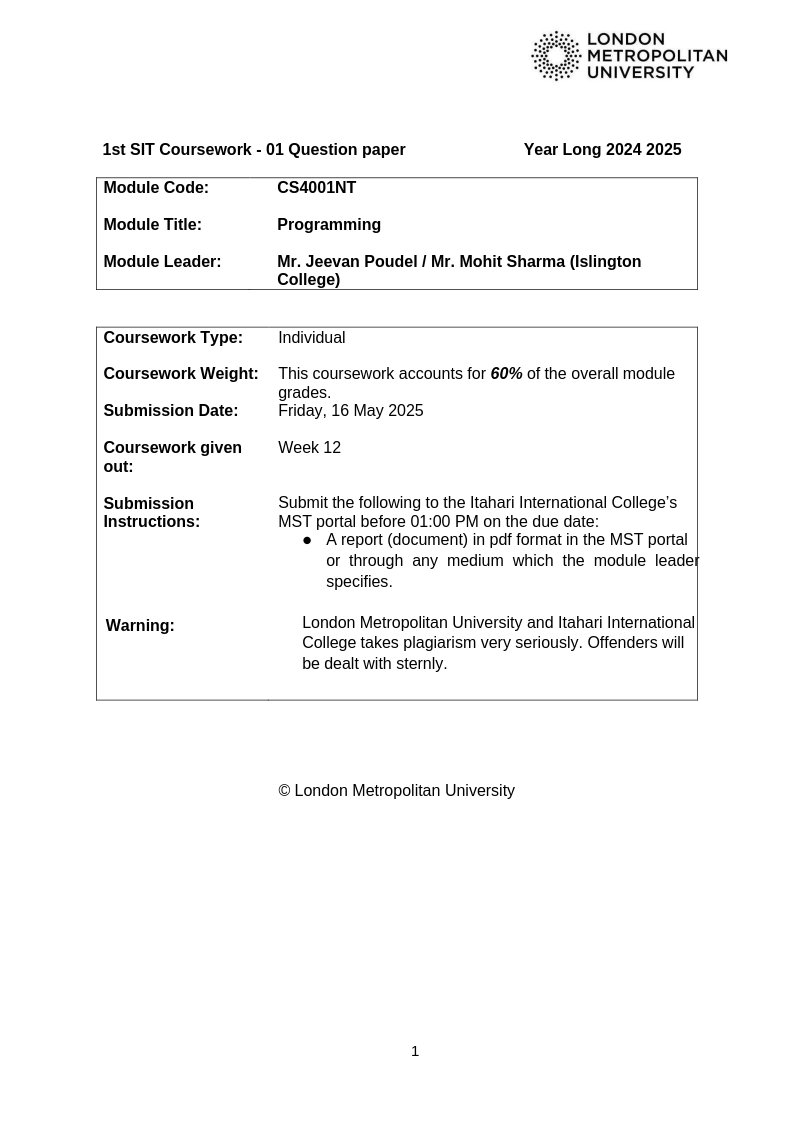

| COURSEWORK QUESTION PAPER (Re Sit) | Summer 2024 Semester |
| Module Code: | AC4058NI |
| Module Title: | Financial Accounting |
| Module Leader: | Bijaya Manandhar (Islington college) |
| Coursework Type: | Coursework 1500 words ● Task 1: 500 words ● Task 2: 1000 words |
| Coursework Weight: | This coursework accounts for 100% of your total module grades. |
| Submission Date: | TBA |
| When Coursework is given out: | TBA |
| Submission Instructions: | Submit the following at the MST platform on a single PDF format. The following naming convention should be followed while submitting: ● 1 x Final Submission PDF ● File name example: 12312324 Darshan Gyawali This coursework has two tasks. ● Task 01: This task has two questions which are compulsory ● Task 02: This task has two questions which are compulsory |
| Warning: | London Metropolitan University and Islington College take Plagiarism seriously. Offenders will be dealt with sternly. |
© London Metropolitan University
Individual coursework 1: Coursework 1500 words (100 marks)
PLEASE READ THE FOLLOWING CAREFULLY


Section A: Learning Outcomes of the Assessment
Learning Outcome(s) addressed by this assessment:
LO 1. Construct a set of financial accounting statements for a sole trader and a limited company, starting from the double entry bookkeeping aspect of recording transactions.
LO 2. Understand and implement the underlying concepts/conventions and comment on the usefulness to users of financial statements prepared.
LO 3. Highlight the decision-making needs of external users of financial reports
Section B: Introduction
The module has one summative assessment. The assessment strategy for the module comprises a piece of coursework which will require students to produce a 1500 words individual piece of work on interpretation and computation of financial statements.
This task must represent the work of individual students and references to published works must be cited. Plagiarism constitutes an examination offence and if discovered will render a student(s) liable to the appropriate provisions of the University’s Examination Regulations.
Section C: Assessment Strategy
Task 1 – Construction of financial statements (Attempt all) – 36 Marks
Question 1: Construction of the Statement of Comprehensive Income and Financial Position – 18 marks
Mr. Bob John, Manager of Three Star International Hospitality has suggested your name to the financial and advisory committee regarding preparation of the set of financial statements of the year ended 31 December 2023 of Three Star International Hospitality.
| Account Heads | Dr | Cr |
| £ | £ | |
| Debtors | 15,000 | |
| Directors’ salary | 6,800 | |
| Electricity | 8,000 | |
| Audit and Accountancy | 700 | |
| Transportation | 840 | |
| Cash and Bank | 2,300 | |
| Creditors | 10,000 |
Page 2 of 12
| Long Term Bank Loan | 4,100 | |
| Sales Revenue | 400,000 | |
| Inventory (at 1.1.2023) | 13,400 | |
| Salaries and Wages | 20,000 | |
| Bank Interest | 620 | |
| Insurance | 3,440 | |
| Office Furniture | ||
| At cost | 68,000 | |
| Accumulated depreciation (at 1.1.2023) | 22,600 | |
| Motor Vehicle | ||
| At cost | 35,000 | |
| Accumulated depreciation (at 1.1.2023) | 2,700 | |
| Purchases | 305,500 | |
| Rent and Rate | 5,100 | |
| Office expenses | 13,000 | |
| Ordinary £1 shares (issued and fully paid) | 32,000 | |
| Profit and loss account (at 1.1.2023) | 26,300 | |
| Total | 497,700 | 497,700 |
Additional Information:
1. Stock at 31st December 2023 valued at cost amounted to £15,000.
2. Depreciation is to be provided on Office furniture at 15% on reducing balance method, 10% on straight line method for motor vehicle.
3. Electricity charges yet to pay for £400.
4. Insurance paid in advance on 31st December 2023 amounted to £2,000.
Required tasks
1. Prepare Income statement for the year ended 31st December 2023. 2. Prepare Balance Sheet as of 31st December 2023.
3. Identify FIVE accounting concepts that have been applied in the preparation of financial Statements with the supporting evidence and also explain their meaning.
Question 2: Construction of the Statement of Cash Flow using Indirect Method – 18 marks
The following statements of financial positions for the year ended 31st December 2022 and 31st December 2023 have been prepared for XYZ Foundation limited
| Statement of financial positions at: | 31-Dec-23 | 31-Dec-22 | ||
| £ | £ | £ | £ | |
| Non-current assets | ||||
| Plant and machinery at cost | 48,600 | 48,600 | ||
Page 3 of 12
| Less: Depreciation | (11,850) | (8,510) | ||
| 36,750 | 40,090 | |||
| Investments at cost | 17,000 | 26,000 | ||
| Total Non- current assets | 53,750 | 66,090 | ||
| Current assets | ||||
| Inventory | 40,000 | 21,000 | ||
| Trade receivables | 18,500 | 14,050 | ||
| Cash | 1,900 | – | ||
| Total Current assets | 60,400 | 35,050 | ||
| 114,150 | 101,140 | |||
| Capital and reserves | ||||
| Ordinary share capital | 22,000 | 22,000 | ||
| Share premium account | 8,060 | 8,060 | ||
| Retained earnings | 10,500 | 3,500 | ||
| Total Shareholders’ funds | 40,560 | 33,560 | ||
| Non-current liabilities | ||||
| Loans | 43,140 | 10,160 | ||
| Total Non- current liabilities | 43,140 | 10,160 | ||
| Current liabilities | ||||
| Trade payables | 30,450 | 27,420 | ||
| Bank overdraft | – | 30,000 | ||
| Total Current Liabilities | 30,450 | 57,420 | ||
| 114,150 | 101,140 | |||
Additional information:
There were no purchases or sales of plants and machinery during the year. Required
Page 4 of 12
1. Mr. Jonas has asked you to prepare ABC Foundation Limited’s statement of cash flows using indirect methods for the year ended 31st December 2023.
2. Write a short memo to Mr. Jonas explaining the business performance findings of your statement of cash flow.
Task 2 – 64 Marks (Attempt All)
Question 1: Understanding Business Performance using Financial Analysis – 54 marks
YOU ARE REQUIRED to prepare a financial report for a company listed on the London Stock Exchange. The report must take into account the viewpoints of all corporate stakeholders.
Following is the data on ratio analysis of Goodwin PLC
GOODWIN PLC
Apr 23
Apr 22
Apr 21
GBP GBP GBP
Profitability ratios
| ∟ Earning Per Share (Units) (Net Profit / Number of Shares) | 206.8 1 | 169.1 4 | 167.8 2 |
| ∟ Return on Capital Employed (%) (Operating Profit / Capital Employed) × 100% Capital Employed = (Net Debt + Equity Shareholder’s Fund) | 12.9 | 12.6 | 13.1 |
| ∟ Gross margin (%) (Gross Profit / Turnover) × 100% | 24.9 | 29.6 | 29.7 |
Operational ratios
| ∟ Dividend Coverage Ratio (x) Profit After Tax / Dividend Payable | 14.2 | 1.6 | 1.7 |
| ∟ Interest Coverage Ratio (x) Profit before Interest & Tax / Net Interest Payable | 14.2 | 15.7 | 26.8 |
| ∟ Stock Turnover (x) ((Stock × (365/Cost of Sales)) | 125 | 145 | 137 |
| ∟ Debtor Collection (days) Trade Debtors × (365 / Turnover) | 55 | 57 | 54 |
Structure ratios
| ∟ Current ratio (x) Current Assets / Current Liabilities | 1.64 | 1.93 | 2.11 |
| ∟ Liquidity ratio (x) (Current Assets Less Inventories) / Current Liabilities | 1 | 1.11 | 1.35 |
Page 5 of 12
∟ Gearing (%)
(Net Borrowing / Shareholder’s Fund) × 100%
26.3 25.8 15.4
No other company will be accepted. You have to use the financial number of those three published annual reports to perform the analysis.
REQUIRED
The report should be structured with section headings, etc., and should be addressed to your supervisor (use your seminar tutor’s name). The report should contain the following:
(a) Introduction
● The introduction should summaries the aims and objectives of your report ● Together with any limitations in this type of financial analysis.
● It should also give a brief profile of the company,
● its markets and products and
● A brief commentary on its key operations and recent trading background.
(b) Ratio Analysis
● Calculation of accounting ratios as provided together with any other relevant data to evaluate the relative performance and financial status of the companies.
● The trend analysis should be made from the viewpoints of the company’s’ key stakeholders (management, investors and lenders).
● You may use ratios published within the annual reports plus ratios calculated yourself (the workings for which should be shown in an appendix).
● The comparison must be year on year for each company.
● Appropriate use of graphs and table to perform the analysis
(c) Performance factors
● Research and discuss any financial factors that may have affected the company’s performance during the periods under review, with reasons.
● Research and discuss any non-financial factors that may have affected the company’s performance during the periods under review, with reasons.
● This must take into account the performance of the different segments of the businesses as shown in the annual reports as well as all other relevant factors.
● These factors must be specific to your chosen companies.
Note: This information can be obtained from various commentaries within the annual reports, corporate websites, trade journals and financial press websites. You must show the source of the information that you use in this section.
(d) Overall Report Presentation (including report structure, grammar and spelling)
Page 6 of 12
(e) Appropriate in text citations and bibliography
Marking Criteria of the task
● Word limit 1000 words (excluding any information supplied in appendices).
How to get better result:
● Evidence that you can apply your knowledge of financial analytical tools to a specific company.
● Demonstration of your understanding of the implications of the environment in which the company operates and its ability to perform well.
● Evidence of your capability to search for and use source material. A reading list should be given. All sources used should be specifically cited as mentioned. Good use of citations enhances the credibility of your findings, as they demonstrate that you have carried out an adequate search for information and can substantiate your views.
Access to financial statements of companies
You need to visit the website of the respective companies and access their annual report to access their financial statements. Please take support from the module tutor to search those online. It is not necessary to print off the entire financial report. You can extract the main financial statements and only those sections which are relevant to your report.
Question 2: Learning Reflection – 10 marks
This task requires reflection to provide insights into the process and quality of personal learning. Your reflection should focus on your actions, motivations and emotions and should analyse what changes will be made to practise in light of experiences, feedback and reflection. A good reflection will help you understand what, why and how you learn.
Note you should not comment on the theories of reflection. You should also not evaluate teaching or the module for this exercise.
Section D: Assessment Submission
The student must work individually to develop the answers to the given assignment. There is no tolerance for COLLUSION.
The student should submit one final file for each task in a pdf format to RTE on the given deadline. The word limit of the final report is a 1500-word limit excluding appendices and bibliography. Submissions of excessive length, or which attempt to subvert length criteria with the misuse of appendices, will be penalised.
Standard University regulations regarding plagiarism will apply and be rigorously enforced. THIS INCLUDES THE USE OF PUBLISHED SECONDARY RESEARCH (E.G. MINTEL, ETC.) WITHOUT ACKNOWLEDGEMENT AND/OR INTERPRETATION. The course tutor will also apply penalties to submissions which in his/her sole opinion show evidence of collusion.
Page 7 of 12
Section E: Marking Criteria: How will you be evaluated?
Task 1:
Accuracy of the number calculated
Use of Prescribed Format to develop the financial statement
Evidence of clear workings shown
Use of relevant concepts learned in the model and use of references
Quality of interpretation of financial performance
Task 2:
(a) Introduction
● Summary of the aims and objectives of your report
● Limitations in this type of financial analysis
● a brief profile of the company and its markets and products
● A brief commentary on its key operations and recent trading background
(b) Ratio Analysis
● Definition, formula, expectation, business performance, calculated numbers) ● Presentation of calculated numbers in the given table
● Trend analysis (Table and graphs)
(c) Performance factors
● Key Observations of the financial analysis
● supported by relevant Financial Factors and Non-Financial Factors affecting business performance
● Conclusion & Summary of overall business performance
(d) Overall Report Presentation (including report structure, grammar and spelling) (e) In text citations and bibliography
(f) Learning Reflection
Section F: Recommended Table of Contents
| Task 1 |
| Cover Page |
| Table of Contents |
| Q.1. (with working note) |
| Q.2. (with working note) |
| Bibliography |
| Appendices |
| ● Hand written work of the income statement ● Hand written work of the financial position ● Hand written work of the cash flow statement |
| Task 2 |
Page 8 of 12
| Cover Page |
| Table of Contents |
| Q.1. (with working note) |
| Q.2 |
| Bibliography |
| Appendices |
| Learning Reflection |
Section G: Recommended Readings for References
Reference Text textbook
● Scott, P (2018), Introduction to Financial Accounting OUP.
● Scott, P (2018), Introduction to Accounting OUP.
● Carey M., Knowles C. and Towers-Clark J. (2016) Accounting a smart approach Oxford University Press www.oxfordtextbooks.co.uk/orc/carey/
● Annual reports of Selected Company
Section H: Assessment Grade Description
GSBL UNDERGRADUATE GENERAL GRADE DESCRIPTORS
| Level 3 or 4 | Level 5 | Level 6 | |
| General | Acquisition of broad knowledge Evaluate information Use the information to plan, develop and problem solve | Generate ideas through analysing concepts Demonstrate command of specialised skills Formulate responses to well-defined and abstract Analyse and evaluate information | Critically review, consolidate and extend a body of knowledge using specialised skills Critically evaluate concepts and evidence from a range of sources Transfer and apply skills and exercise significant judgement in a range of situations |
| 70-100 (A) | Very good Demonstration of a very good comprehension of the task with evidence of analysis, synthesis, evaluation and critical appraisal | Excellent Advanced scholarship Goes beyond the material provided Excellent link to research Excellent analysis, synthesis, evaluation and critical appraisal | Excellent – Outstanding (for use at far end of range) Outstanding understanding, exploration and insight Strong evidence of originality and |
Page 9 of 12
| Use of a wide variety of appropriate sources Transformation of knowledge Independent thinking and development of ideas Ability to communicate very clearly and effectively Very good evidence of preparation Very good organisation, structure and presentation of work – minimal errors Good references, appropriate sources (quality and quantity). No errors in reference list or citations. | Excellent evidence of preparation Comprehensive and critical understanding of the topic Excellent ability to communicate clearly and effectively Excellent organisation, structure and presentation of work Good references, appropriate sources (quality and quantity). No errors in reference list or citations. | development of own ideas Develop a highly complex argument Outstanding ability to communicate topics clearly and concisely Advanced organisation, structure and presentation of work Good references, appropriate sources (quality and quantity). No errors in reference list or citations. References well utilised and critiqued | |
| 60-69 (B) | Very good Demonstration of very good comprehension of the task with evidence of analysis, synthesis, evaluation Use of a wide variety of appropriate sources Transformation of knowledge Independent thinking and development of ideas Ability to communication clearly and effectively Very good evidence of preparation Very good organisation, structure and presentation of work – minimal errors Good references, appropriate sources (quality and quantity). Minimal or no errors in reference list or citations. | Very good Demonstration of very good comprehension of the task with evidence of analysis, synthesis, evaluation Use of a wide variety of appropriate sources Transformation of knowledge Independent thinking and development of ideas Ability to communication clearly and effectively Very good evidence of preparation Very good organisation, structure and presentation of work – minimal errors Good references, appropriate sources (quality and quantity). Minimal or no errors in reference list or citations. | Very Good Advanced scholarship Goes beyond the material provided Very good link to research Very good analysis, synthesis, evaluation and critical appraisal Very good evidence of preparation Comprehensive and critical understanding of the topic Very good ability to communicate clearly and effectively Very good organisation, structure and presentation of work Good references, appropriate sources (quality and quantity). No errors in reference list or citations. |
| 50-59 © | Adequate – Satisfactory Some analysis but limited Some insight and exploration of ideas | Adequate – Satisfactory Some evidence of thinking independently to develop own ideas | Adequate- Satisfactory Evidence of thinking independently to develop own ideas |
Page 10 of 12
| Sound conclusions No significant inaccuracies or omissions Some analysis, evaluation or synthesis of information Lacking clarity at times Some evidence of preparation Referencing is sound. Mostly appropriate sources. Numerous errors or inconsistencies | Evaluation of relevant theories or literature Reasonable ability to communicate clearly and effectively Report information in a structured way Use of an appropriate format Quite comprehensive knowledge Satisfactory evidence of preparation Satisfactory referencing, appropriate sources. Numerous but minor errors in references | Evaluation of relevant theories or literature Ability to communicate clearly and effectively Report information in a structured way Use of an appropriate format Reasonably Accurate, quite comprehensive knowledge Satisfactory evidence of preparation Coherent and well presented – minor errors Satisfactory referencing, appropriate sources. Minor errors in references | |
| 40-49 (D) | All learning outcomes met Competent (practical) May be incomplete in knowledge (some errors or omissions) Insufficient analysis, evaluation or synthesis Limited application of theories/knowledge An awareness of appropriate principles/theories/techni ques Irrelevance to the task at times Disorganised work with weak standard of presentation Numerous aberrations from the requirements of the task Referencing is attempted although may be inconsistent, many errors, weak sources | All learning outcomes met Competent (practical) May be incomplete in knowledge (some errors or omissions) Weak or no analysis, evaluation or synthesis Some application of theories/knowledge An awareness of appropriate principles/theories/techni ques Irrelevance to the task at times Disorganised work with weak standard of presentation Aberrations from the requirements of the task Referencing is attempted although may be inconsistent, many errors, weak sources | All learning outcomes met Competent (practical) May be incomplete in knowledge (some errors or omissions) Weak or no analysis, evaluation or synthesis Some application of theories/knowledge An awareness of appropriate principles/theories/techni ques Irrelevance to the task at times Disorganised work with weak standard of presentation Aberrations from the requirements of the task Referencing is attempted although may be inconsistent, many errors, weak sources |
| Condon ed Pass | Learning outcomes not met Little relevant knowledge | Learning outcomes not met Little relevant knowledge | Learning outcomes not met Little relevant knowledge |
Page 11 of 12
| 30-39 (R2/F1) | Lacking structure Numerous errors in structure and form Limited understanding of concepts/theories No appropriate analysis, evaluation or synthesis Significant inaccuracies/omissions Not competent Little or no attempt to use references and if so very weak with errors | Lacking structure Numerous errors in structure and form Limited understanding of concepts/theories No appropriate analysis, evaluation or synthesis Significant inaccuracies/omissions Not competent Little or no attempt to use references and if so very weak with errors | Lacking structure Numerous errors in structure and form Limited understanding of concepts/theories No appropriate analysis, evaluation or synthesis Significant inaccuracies/omissions Not competent Little or no attempt to use references and if so very weak with errors |
| Under 30 (R2/F2) | Little engagement with the task No basic understanding of the subject matter Poor communication (written or verbal) Lacking or no structure Significant errors in structure and form Many significant inaccuracies/omissions – very little correct Little or no attempt to use references and if so, very weak with many significant errors | Little engagement with the task No basic understanding of the subject matter Poor communication (written or verbal) Lacking or no structure Significant errors in structure and form Many significant inaccuracies/omissions – very little correct Little or no attempt to use references and if so, very weak with many significant errors | Little engagement with the task No basic understanding of the subject matter Poor communication (written or verbal) Lacking or no structure Significant errors in structure and form Many significant inaccuracies/omissions – very little correct Little or no attempt to use references and if so, very weak with many significant errors |
| (0%) | No submission Nothing of relevance in the work submitted | No submission Nothing of relevance in the work submitted | No submission Nothing of relevance in the work submitted |
– End of Document –
Page 12 of 12